The silent changes to the Constitution difficult to challenge: Highlights from the 29th Justice Sunanda Bhandare Memorial Lecture
Senior Advocate Indira Jaising and Chief Justice D.K. Upadhyaya of the Delhi High Court spoke about what constitutionalism in modern India stood for
Published on: 23 February 2025, 10:42 am
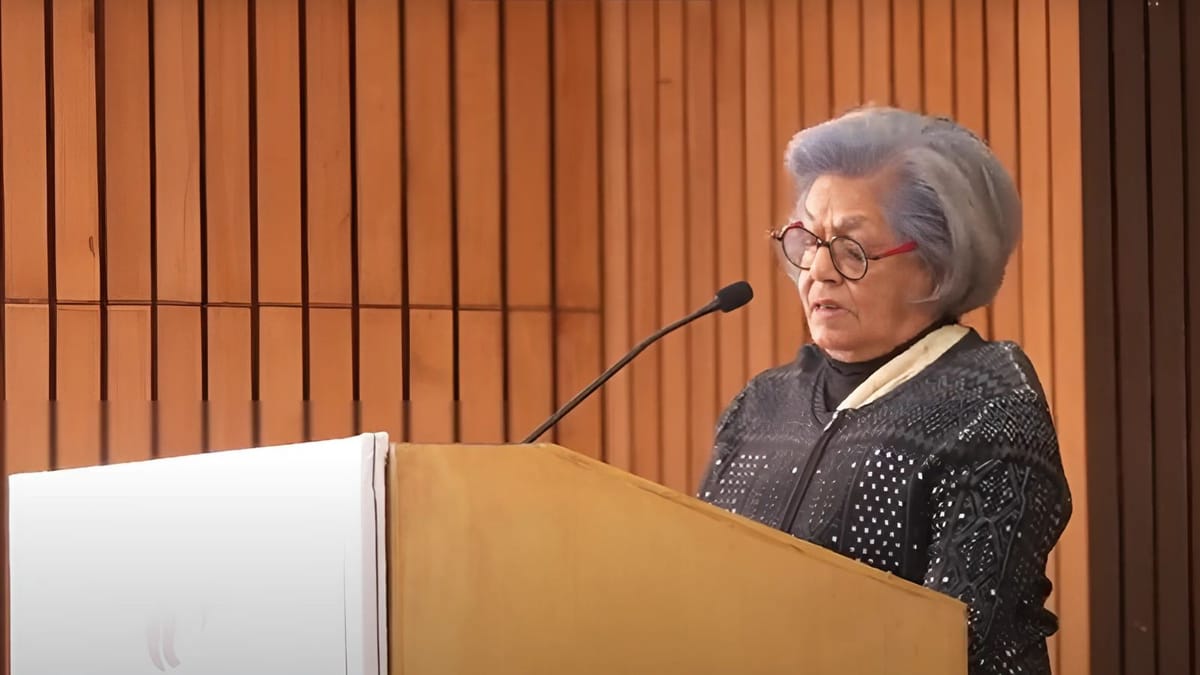
ON Friday, before a packed hall in the India International Centre in Delhi’s Max Mueller Marg, Senior Advocate Indira Jaising took the podium to address the gathering on ‘India’s Modern Constitutionalism.’
Jaising was here to deliver the 29th version of the Justice Sunanda Bhandare Memorial Lecture, which, on previous occasions, had been delivered by personalities such as Nobel Laureate Abhijit Banerjee and former President Pranab Mukherjee.
The event was also presided by Chief Justice Devendra Kumar Upadhyaya of the Delhi High Court as the chief guest. Former Supreme Court judge Madan B. Lokur, who was recently appointed as United Nations Internal Justice Council’s chairperson, and Justice Vibhu Bakhru, Delhi High Court’s acting chief justice until December 2024 also shared the stage.
The first lecture since Senior Advocate and former Odisha governor Murlidhar Bhandare’s passing away last year in June, who oversaw the annual lecture for decades, the event was partly nostalgia, and partly grounded in the present. Underlying the discussions was an acute awareness of the precarious challenges confronting constitutionalism in the country.
He noted that authoritarian regimes may have the facade of hosting a grundnorm document, without actually practising the principles that define constitutionalism.
Authoritarian regimes may have Constitutions, but no constitutionalism
Chief Justice Upadhyay highlighted that talking about constitutionalism was contemporarily important because there was a crucial difference between having a Constitution, and practising its principles. Without twisting words, he noted that authoritarian regimes may have the facade of hosting a Constitution, without actually practising the principles that define constitutionalism. He highlighted that Adolf Hitler, the Nazi German chancellor who led the 'Holocaust' against European Jews in the second World War, had also been elected to power legally. But he could not have consolidated the power if not through amending existing laws. Justice Upadhyaya was referring to the fact that in March 1933, the Reichstag had enacted the Enabling Act, which allowed Hitler to enact laws without interference from the President or Reichstag for four years.
The chief justice praised the Indian Constitution’s provisions on reservations, which ensured that Indians from marginalised communities were included in the Constitution’s vision of “power sharing.” He noted that this was aspired for by Dr. B.R. Ambedkar, who had taken inspiration from affirmative action policies for African-American citizens in the U.S.
Chief Justice Upadhyaya highlighted that modern constitutionalism was being shaped through academic discourse as more and more judges now referred to academic scholarship to enrich their understanding of constitutional history.
No feminism without constitutionalism, no constitutionalism without feminism
Jaising noted that constitutionalism played a crucial role in recognising and effectuating the fundamental rights of Indian citizens. It imposed certain inherent limitations on State power and “its dealings with citizens”, ensuring that the State could not trample upon citizens’s rights.