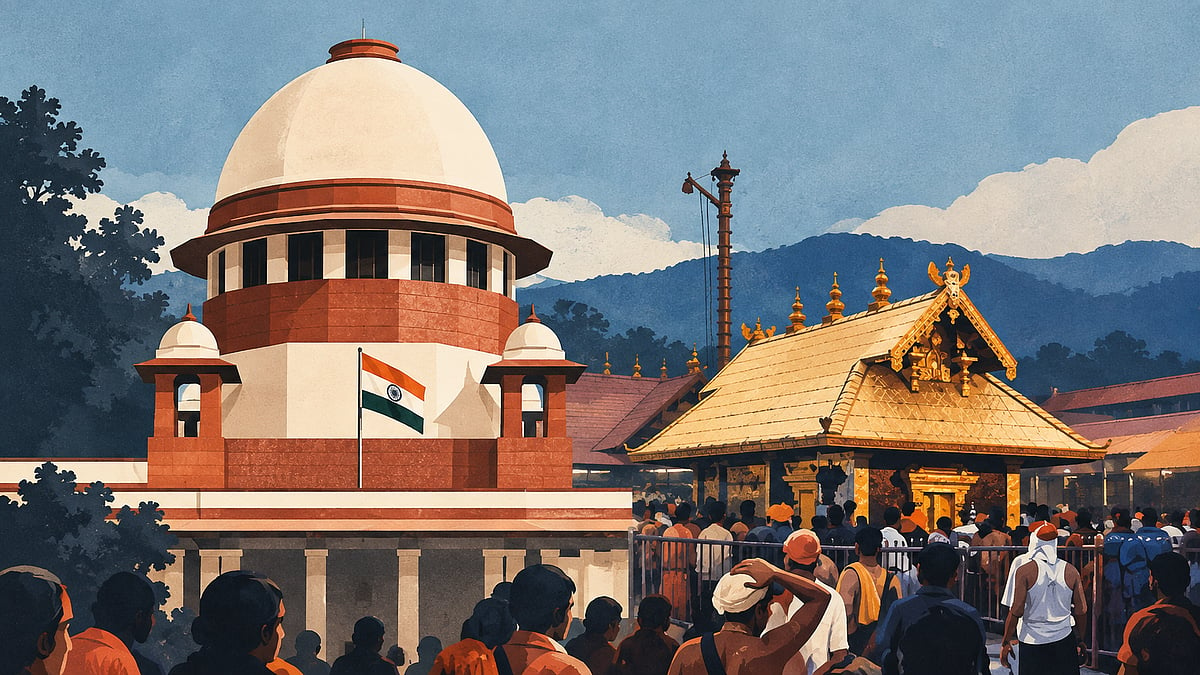
Last Thursday, as the Supreme Court reserved judgment following sixteen full days of hearings, respondents discouraged relying on the doctrine of proportionality in reading Articles 25 and 26, while the Union opposed the ERP test.
As the Sabarimala Reference hearings completed a fortnight, senior advocates Jaideep Gupta, Sanjay Hegde, Vijay Hansaria, Meneka Guruswamy and Shadan Farasat for the respondents argued on the intent of the Constitution drafters to open temples to ‘all classes’ and the perils of acceding to public morality.
On the thirteenth day of hearings, Respondents pressed that the practice of excommunication in the Dawoodi Bohra community led to suffering across generations, and that ‘morality’ in Article 25 must be construed as the Constitution’s ‘internal morality’.
While Senior Advocate Khambata cautioned the Bench against conflating religious autonomy with denominational dominance and urged it to read constitutional silences not as vacuums, Senior Advocate Ramachandran brought before the Court the lived consequences of excommunication within the Dawoodi Bohra community.
While the Indian Young Lawyers' Association struggled to justify its standing before the Court, Senior Advocate Darius Khambata, appearing for a Parsi Zoroastrian woman denied entry into the agiary after marrying a Hindu man, argued that no religion can strip a believing woman of her faith simply because she married outside her community.
With hate speech events averaging four a day and a nine-year-old Law Commission recommendation still unheeded, the Supreme Court's refusal to act meaningfully leaves the Constitution’s promise of equal protection suspended between two branches of government.
Senior Advocate Indira Jaising opened arguments for Respondents by placing exclusion at the heart of her submissions and arguing that the Constitution, as the grundnorm, admits of no higher norm, and certainly not one built on notions of pollution and defilement.
As the review petitioners wrapped up, the nine-judge Bench heard wide-ranging submissions on who can challenge religious practices, whether Article 25(2) can override denominational autonomy under Article 26, and whether the 2018 Sabarimala judgment itself is liable to be recalled.
Three weeks on, the Review Petitioners in the Sabarimala Reference emphasise on legislative morality, non-believers filing PILs against religious practices, harmonious reading of Articles 25 and 26, and limits of the ERP test on Islamic practices.