The true legacy of ‘Due Process’: N. Kavitha Rameshwar’s book shows how a resurrected constitutional safeguard shaped India
‘They Created a Nation’ explores the winding journey of the ‘due process’ clause in Article 21 – from Frankfurter’s warning to Justice Subba Rao’s act of resurrection – and the judicial innovation it has enabled over 70 years.
Published on: 6 July 2026, 02:52 pm
BEFORE THE DRAFT CONSTITUTION of 1948 provided that no person could be deprived of their life or personal liberty "except according to procedure established by law,” the interim report of the Advisory Committee on Minorities and Fundamental Rights (1947) stated that "No person shall be deprived of his life or personal liberty, without due process of law, nor shall any person be denied the equal treatment of the laws within the territories of the union” (emphasis ours).
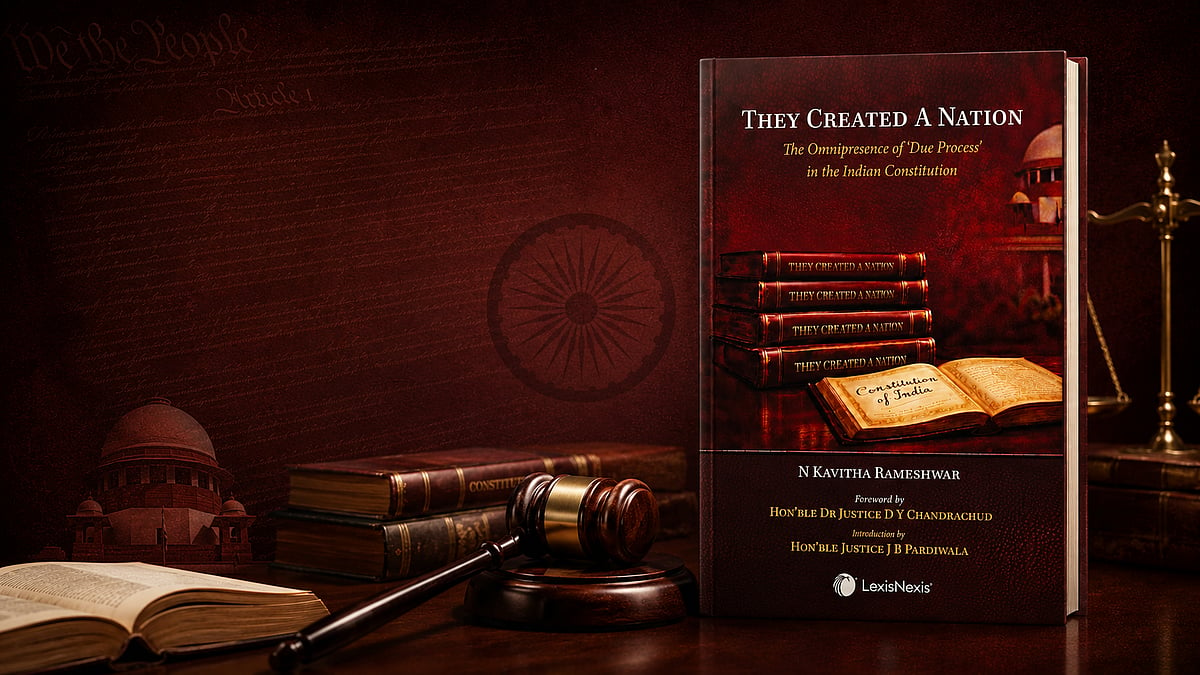
The phrase “due process of law” lies at the heart of N. Kavitha Rameshwar’s book “They Created a Nation” (LexisNexis, 2026), which centres around the gradual resurrection of the original phrase by the Judiciary while broadening the scope of Article 21.
The book carries the expression of ‘due process of law’ as a yardstick for state action in both its substance and its application, and justifies the exercise of reading beyond the text of the Constitution to enforce the scheme of constitutionalism by the judiciary. As one of the important pointers of development in the Indian Constitution, the book records how the Supreme Court embraced it, acknowledged it and sometimes failed to use it in simple terms. In the end, the utilization of this expression by the judiciary to broaden the scope of Article 21, reading the directive principle of state policy in order to recognize the rights of disabled, the LGBTQ+ community, and victims of intersectionality, created the Nation.
The phrase “due process of law” lies at the heart of N. Kavitha Rameshwar’s book “They Created a Nation” (LexisNexis, 2026), which centres around the gradual resurrection of the original phrase by the Judiciary while broadening the scope of Article 21.
The winding story of how Article 21 was shaped
The book is divided into two registers: the first half traces the genealogy of the phrase. The phrase “due process of law”, derives its constitutional legitimacy in the Fifth and Fourteenth Amendments of the U.S. Constitution. Richard Posner described it as a ‘durable oxymoron’ – testing the state regulation for being unreasonable resulting in ‘deprivation of life, liberty, or property’ and then when adopted, it must be in conformity with the most rigorous ‘procedural safeguards’. The author then turns towards the Indian Constituent Assembly’s own record, and the tussle between the Advisory Committee’s stance on adopting the ‘due process doctrine’ in the Constitution against the Drafting Committee’s borrowing of Article 31 of the Japanese Constitution to incorporate ‘procedure established by law’. The author records B.N. Rau’s reservation with the doctrine, that it would enable judges to ‘veto over legislative policies’, much of which came from Justice Felix Frankfurter’s restraint for judicial outreach. In contrast to B.R. Ambedkar’s stance, centred around the problem that whether the unelected judges should be vested with the authority to invalidate the legislation on substantive grounds?
As Rameshwar reconstructs this history, one sees the irony apparent in the story of how Article 21 came to be shaped – a doctrine which was once deliberately left out of the Constitution was eventually brought back into it via judicial interpretation.
The second half of the book explores the doctrinal pendulum swings that have come to define the Supreme Court’s approach to this jurisprudence, moving from a strict approach taken in A.K. Gopalan v. State of Madras (1950), where "procedure established by law" was interpreted in a very narrow manner, to the broader approach followed in Maneka Gandhi v. Union of India (1978). The ruling in Maneka Gandhi would become a validation of sorts to the dissenting opinion of Justice Fazl Ali in A.K. Gopalan.
Through Maneka Gandhi, Rameshwar explains the doctrine of ‘due process of law’ would re-enter through the back door even though the front door of the constitutional text remained shut. She argues that the history of Article 21 is not merely a story of textual reading, rather a judicial transformation in itself; by acknowledging the interlinking of Articles 14, 19 and 21, the Supreme Court transformed the ‘procedural fairness’ into a ‘substantive constitutional safeguard’. Resulted in a wider recognition of unenumerated rights of privacy, healthy environment, sexual autonomy, abolition of bonded labour, and more recently the intellectual recognition of ‘intersectional rights of the individuals’ and ‘rights of civil union for LGBTQ+ community’.
The book’s strength lies in its title, the author’s ambitious attempt to weave together constitutional history, transformative theory and the judicial doctrine – and how the idea shaped between the citizen, the state, and the judiciary, resulted in the creation of nation. Although the words ‘They Created’ conveys the idea that the events occurred in the past, the contemporary social struggles with ‘religion, environment, politics, etc.’ proves that creation is still in process.