Indira Jaising’s memoir is a guided tour of the ‘multiple wor(l)ds of lawyering’
More than a nostalgic piece of literature, ‘The Constitution is My Home’ is a secular feminist manifesto with the potential to delineate a ‘Theory of Post-Colonial Indian Political Thought and Jurisprudence’.
Published on: 12 June 2026, 01:03 pm
“Whatever one’s preferred route to the constitutional court, there has always been a current of resistance […] against the repressive power of the State. Democratic lawyering must, therefore, also serve as a dual function: as a shield against authoritarianism as well as a vehicle for social and economic transformation.” (emphasis mine) (Page 44)
“Feminist lawyering, however, begins from a different premise. It accepts that men and women do not occupy equal footing, and the liberal notion of equality between equals is, therefore, structurally inadequate.” (emphasis mine) (Page 47)
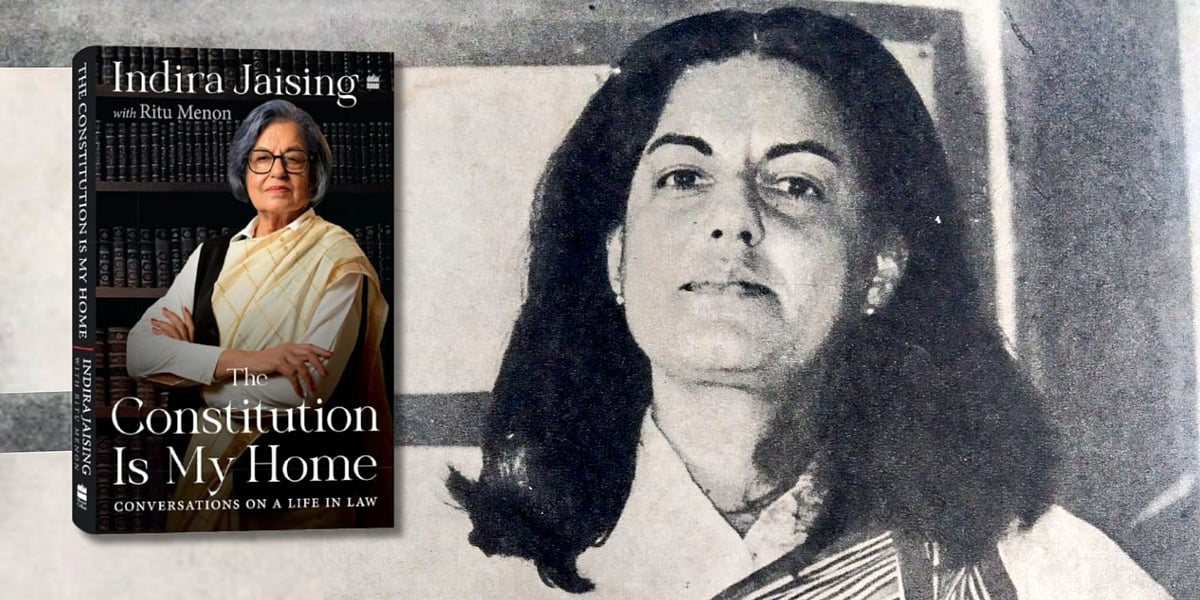
INDIRA JAISING has come out with her memoir – 'The Constitution Is My Home' – and the questions start creeping in right from the first claim: the title. To talk of a constitution as a ‘home’, often referred to as a masculinist hegemonic apparatus of power, as British historian Linda Colley does, discomforts a hasty interlocutor, like me, right at the first note. The affective connotation, “My Home”, is a rare observation, and hence also invites the reader to dive deeper into this dialogical treatise. By the end of the book, one could question whether it is a memoir or a compendium of epochal conversations between the Indian judiciary and multiple public(s).
Writing a review of this short (about 200 pages) but dense book has been quite challenging, not because of Indira Jaising’s grandiose but by virtue of the multiple worlds and words that are consecutively being named and brought to life in this book. For a review like this, there could be two axes of organisation – firstly, chronological, i.e. organising the review documenting the historical occurrences and noting the response of the judiciary to the challenges that the subcontinent put it through; or, secondly, thematic, wherein the different themes of the book could be recorded as flowing organically from Indira Jaising’s responses to Ritu Menon’s questions.
This review is organised around the latter axis to highlight the entanglement of various publics with the judiciary, woven into organically flowing themes, and Jaising, as a narrator, stands at a crucial juncture within those epochal moments, guiding us through the journey.
The book is built from conversations between Jaising and Menon, a feminist writer and publisher, and is divided into nine chapters, along with an Author’s Note. Jaising, in these conversations, as the title of this review suggests, centres lawyering and its multiple interactions with the courts and publics outside. These publics sometimes move, and are at other times moved by the Court. For Jaising, the way forward, as her life’s work, is through “secular feminist lawyering” (emphasis mine) (Page 54).
Combining the broader tenets of feminism and praxis of secularism while holding the institution accountable to the republic’s founding promises (justice, liberty, equality, fraternity and dignity) on the much-contested site of liberal/democratic constitutionalism, Indira poses the questions “Why do you practise law? […] how one practises law, and for whom [sic]” (Page xii). While Jaising is the central protagonist, she puts two other characters under the spotlight – the Courts and the Public(s).