Why is the Supreme Court’s recent judgment on abortion hailed as progressive?
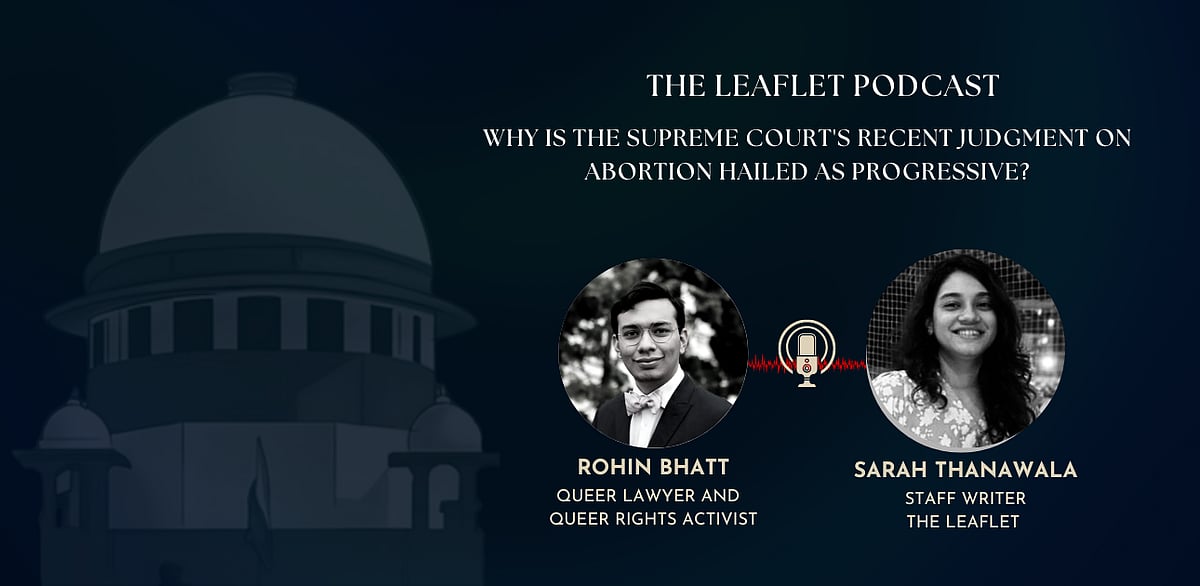
On this episode of The Leaflet’s podcast series, our host Sarah Thanawala interacts with Rohin Bhatt, a queer lawyer and a queer rights activist. In this episode, Bhatt delves into the Supreme Court Judgment in the case of X versus The Principal Secretary Health and Family Department, Govt of Delhi, where the Court held that unmarried and single women, who face a change in their material circumstances, will be able to access abortion between 20 and 24 weeks of pregnancy.
Published on: 16 October 2022, 12:47 pm
ON this episode of The Leaflet's podcast series, our host Sarah Thanawala interacts with Rohin Bhatt, a queer lawyer and a queer rights activist. He is a graduate of Master of Bioethics from Harvard Medical School. He writes on a wide range of topics including queerness, reproductive rights, bioethics constitutional law, and the effects that fascism has on human rights.
In this episode, Bhatt delves into the Supreme Court Judgment in the case of X versus The Principal Secretary Health and Family Department, Govt of Delhi, where the Court held that unmarried and single women, who face a change in their material circumstances, will be able to access abortion between 20 and 24 weeks of pregnancy.
Bhatt explains the provisions under the Medical Termination of Pregnancy Act, 1971 ('MTP' Act), and the Medical Termination of Pregnancy Rules, 2003 that were at the centre of the issue in the Court's expansive interpretation of the abortion law in India. Besides the law, he explains the social barriers to accessing safe and legal abortion, including the social stigma and the fear of the registered medical practitioners, that the Court took due notice of in its judgment.