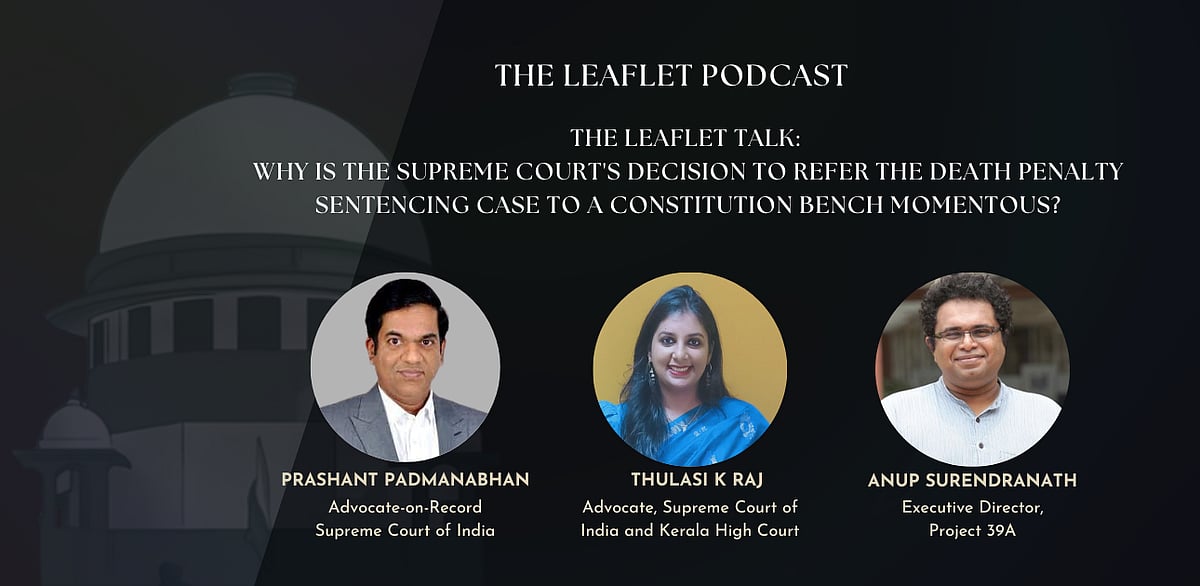
Why is the Supreme Court’s decision to refer the death penalty sentencing case to a Constitution bench momentous?
In this podcast, The Leaflet’s team continues to review the week’s legal news: the stories that made the headlines and also those you may have missed.
Published on: 26 September 2022, 12:36 pm
In this podcast, The Leaflet's team continues to review the week's legal news: the stories that made the headlines and also those you may have missed.

Livestreaming decision
In this episode, we look at the significance of the Supreme Court's decision to livestream the proceedings of the Constitution benches from September 27. We ask why the Court took so long to accept this rather simple demand from the public, and complement senior advocate, and The Leaflet's co-founder, Indira Jaising for nudging the Court to take this momentous decision at this juncture. We also discuss how the Court is going to balance the requirements of transparency with the right to privacy of the litigants, and whether the Court will gradually extend this feature to non-Constitution bench matters as well in the coming days.
Death penalty sentencing guidelines
We also examine another momentous decision of the Supreme Court in referring the suo motu case being heard by a three-judge bench on framing appropriate sentencing guidelines in death penalty cases to a Constitution bench.
Professor Anup Surendranath, Executive director of Project 39A (a criminal justice programme at the National Law University, Delhi, gave us his perspective on why the decision is momentous, as it is the first time the Supreme Court will be reviewing core issues in death penalty juriprudence in such great detail after the landmark decision in Bachan Singh (1980), which held the death penalty constitutional, though other Constitution benches in Mithu versus State of Punjab (1983),and Mohd. Arif (2014), considered other aspects such as mandatory death sentencing and open court hearing in review cases respectively.