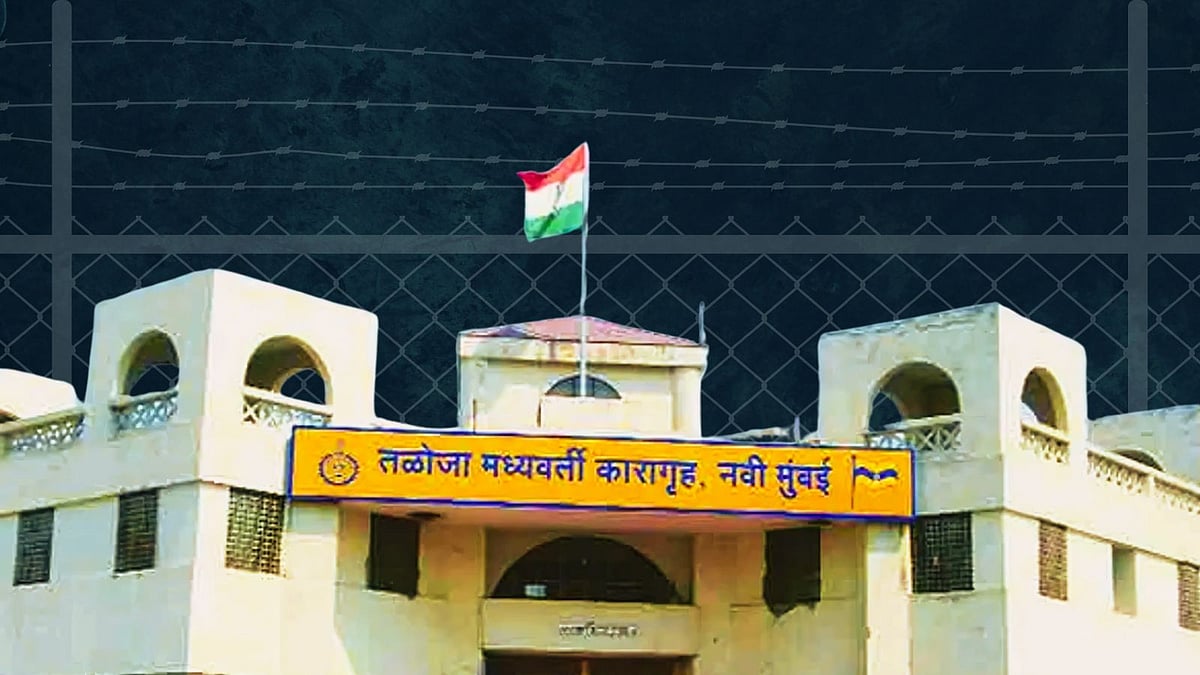
In Taloja jail, interviews with over 300 undertrials show denial of right to counsel, fair trial due to video conferencing of trials
The Supreme Court’s reassurance that video-conferencing improves access to courtrooms misses a crucial point. Through interviews with over 300 prisoners in the Taloja Central Jail, two of India’s foremost civil rights activists reveal how the producing of accused through video-conferencing, and the State’s continual excuse of insufficient police personnel, sustains an architecture of injustice, ripping apart the lives of India’s undertrials.
Published on: 2 March 2025, 01:08 pm
IMAGINE you are watching a court room drama on screen. A crucial witness is being examined. The defence lawyer is trying to elicit the truth from the witness, who is trying to deceive the court. You, as a spectator to the whole drama (and not just the court scenes), know what the lawyer should ask in order to corner the witness, who is deftly trying to avoid stating the whole truth. As an involved viewer you may feel frustrated, unable to aid the cause of truth and justice. But what if the whole drama is about you?
What if your fate - whether you will be thrown into the dungeon for the rest of your life or walk into freedom - were to be decided on the basis of what the lawyer is able to elicit from the witness giving deposition? If trials are going to be held by video conferencing and the accused is forced to remain a mute spectator confined in a prison unable to communicate with his lawyer during the trial, this is going to be an everyday occurrence in our courts.
Keeping up with transitions across institutions globally, courts are increasingly moving to a virtual or hybrid mode.However, these reforms cannot be at the cost of prejudicing the accused, who is entitled to fair trial.
The right to be represented by a counsel and the right to have consultations with the counsel are both fundamental rights guaranteed under Article 21 and 22 of the Constitution
The right to be represented by a counsel and the right to have consultations with the counsel are both fundamental rights guaranteed under Article 21 and 22 of the Constitution, and statutory right as outlined in the Code of Criminal Procedure, 1973 and the Bharatiya Nagarik Suraksha Sanhita, 2023. No defence will be meaningful and effective unless there is proper consultation between the defendant and his lawyer and the defendant gives proper instructions to the lawyer,
Let us take a look at the channels of communication available between a prisoner and his lawyer. Currently, there are four official channels of communication:
(i) Letters sent through post
(ii) Phone calls
(iii) Physical prison visit by the lawyer (Mulaqat) and
(iv) Virtual/E-Mulakat.
Unfortunately, none of these channels are secure and, therefore, fail to ensure the confidentiality of privileged communication between a lawyer and his client.
Prison staff invariably read letters, even scanning and sending them to investigation or other state agencies at times. Phone calls from prison are only for a few minutes and cannot be timed according to the lawyer’s convenience. Prison visits entail sacrificing half a day's work for a lawyer, which only few can afford to. E-Mulaqat suffers from similar problems.
Court visits for a prisoner, then, are crucial not only for the court proceedings, but because they provide an opportunity to communicate with the lawyer. It is in this context that, in April 2023, the Aurangabad Bench of Bombay High Court in Ganpat Baburao Kharat v. State of Maharashtra (2023) directed the Maharashtra government to build “sufficient number of transparent glass chambers in the court premises” to ensure that the undertrial prisoner has access to free and unintimidated professional communication with his lawyer.