Demolish, then disenfranchise: Urban planning as the new instrument of political engineering
Theoretically, adult suffrage under Article 326 of the Constitution is decoupled from housing status, ensuring that the right to vote cuts across social divisions. But the recent spate of demolitions without rehabilitation and the corresponding weaponisation of Form 7 has birthed a mechanism to purge the poor from democratic participation.
Published on: 15 August 2025, 05:16 am
JUSTICE ANTONIN SCALIA REPEATEDLY EMPHASISED that the separation of powers is the Constitution’s most effective safeguard against tyranny. In his opinion in Morrison v. Olson (1988), he wrote that the Constitution does not rely on the good intentions of officials, but on the division of power among branches to prevent abuse. For Scalia, structural separation itself was the biggest check on power.
Each battle to save a slum from demolition leaves an indelible mark of injury on my heart, a wound that festers with the pain of displaced lives and silenced voices. I have failed in escaping unscathed from the human toll of these struggles – especially now that I see a chilling pattern. With each large-scale demolition, the state’s immediate objective of quelling dissent is but a veneer for a deeper, more insidious aim—to inflict a thousand quietly weeping wounds on our democracy. These acts, by stripping citizens of their constitutional right to vote under Article 326 of the Constitution, erode the very soul of India’s democratic fabric, leaving behind a legacy of disenfranchisement and despair.
Theoretically, adult suffrage under Article 326 is decoupled from housing status, ensuring every citizen above 18 retains the right to vote, regardless of whether he resides in a castle or in a barrack. A homeless person carries the same right as a millionaire living in a mansion – and that is the essence of equality before the law.
Under the law, a voter is tagged to a constituency for convenience and making logistical arrangements for them to vote. The Representation of the People Act, 1950 (‘RP Act’), under Section 19, requires only "ordinary residence" in a constituency. This test of “ordinary residence” is enabled by Article 326 which provides every adult citizen has a right to vote if such person “is not otherwise disqualified under this Constitution or any law made by the appropriate Legislature on the ground of non-residence, unsoundness of mind, crime or corrupt or illegal practice”
A homeless person carries the same right as a millionaire living in a mansion – and that is the essence of equality before the law.
In fact, the Election Commission of India (‘ECI’), in an X (formerly Twitter) post, has clarified that it will also include homeless citizens, verified through field inquiries. In practice, however, this right is undermined by bureaucratic hurdles and arbitrary voter deletions post-demolitions. The Booth Level Officers are slaves to documents showing residence.
Section 21 of the RP Act requires annual updates to electoral rolls, while Form 7 under the Registration of Electors Rules, 1960, governs objections to voter inclusions or deletions, where the law explicitly, in Rule 19, requires a pre decisional hearing and reasonable notice to uphold natural justice.
The Delhi High Court’s landmark ruling in Sudama Singh v. Government of NCT of Delhi (2010) further reinforced that evictions without prior rehabilitation violate Article 21’s guarantee of life and dignity, which encompasses the right to civic participation. The Delhi Urban Shelter Board’s 2015 Rehabilitation Policy requires in situ resettlement and relocation in extreme cases.
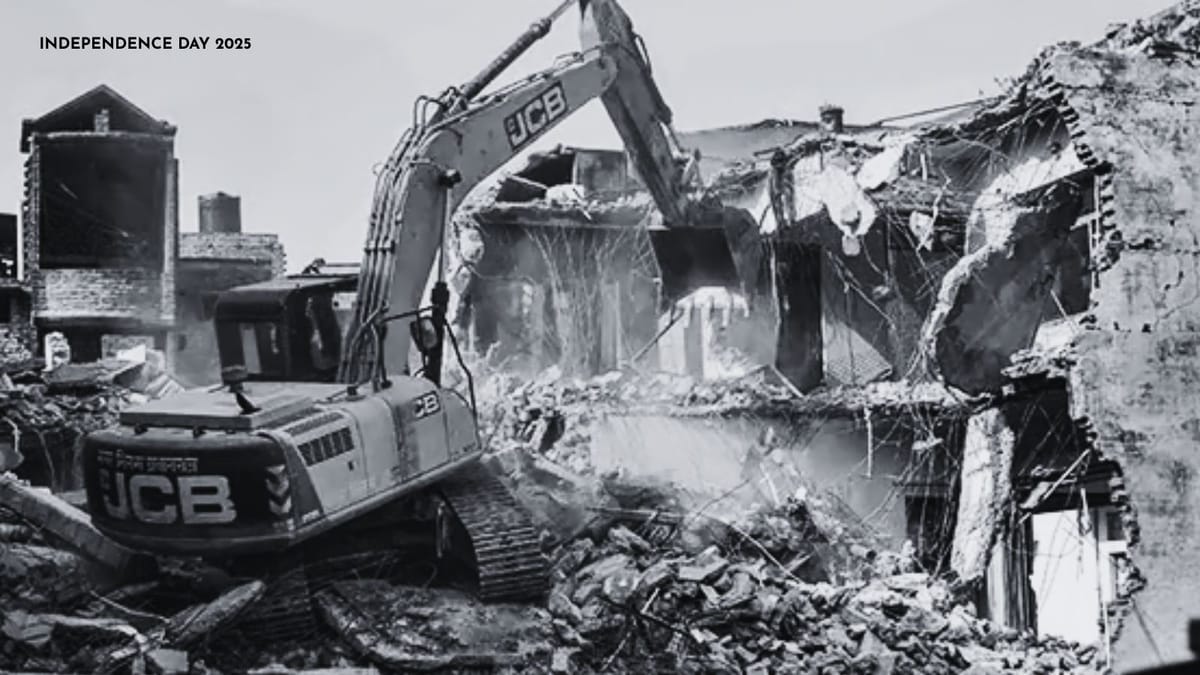
However, the recent spate of demolitions show that the Delhi Development Authority’s (‘DDA’) preferred mode is demolition without rehabilitation. Those who are able to navigate the legal hurdles may get alternative accommodation to EWS flats in regions far away from the urban centre. This means that voters in one part of Delhi can be removed from the electoral list once their jhuggi is demolished – on the ground that they have shifted their residence.