Demolish, delete, deport: Bulldozing workers’ suffrage
Who are the residents, and who are the encroachers? Across informal settlements in India’s urban centres, ceaseless demolitions, combined with judicial complicity, have emerged as means of engineering working class populations out of the electoral process. In response, the affected have invoked their suffrage.
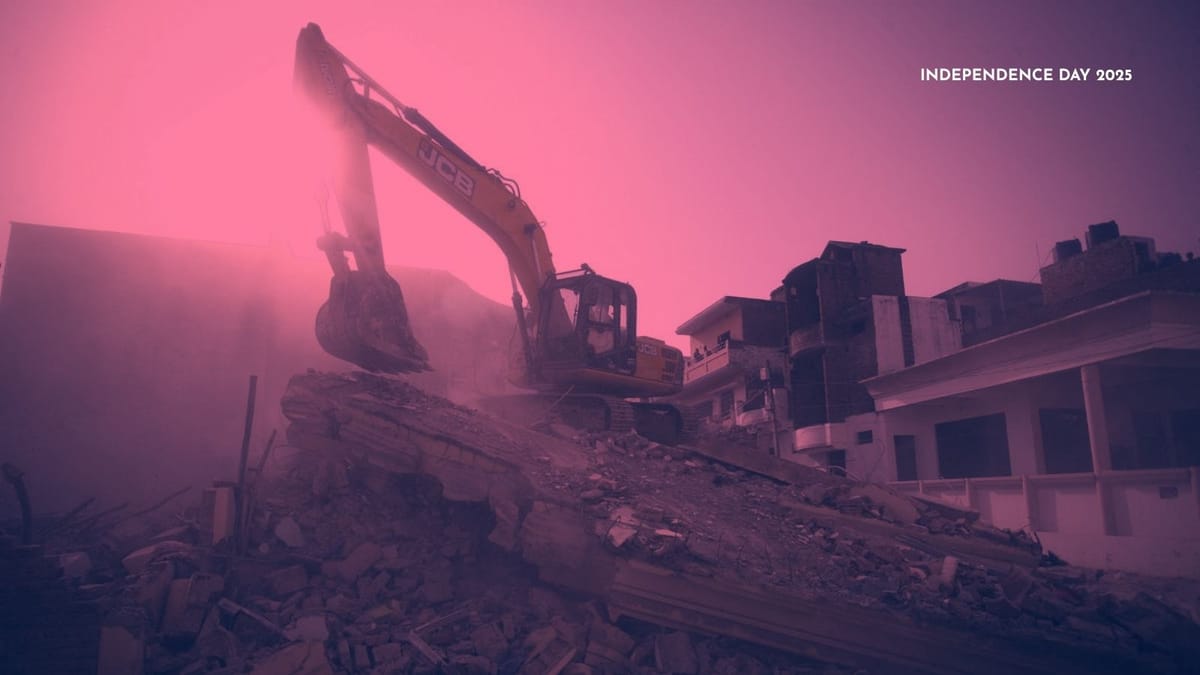
Published on: 15 August 2025, 05:20 am
ON MAY 15, 2023, TWO WEEKS after more than 1000 homes were demolished in South Delhi’s Tughlakabad, the displaced people gathered at Jantar Mantar for a protest.
A day prior to the protest, as we sat with a group of women on the rubble of their demolished homes and explained the travel arrangements to Jantar Mantar, one of them, Reena Singh, asked, “Shall we take our voter cards along? We want to hold those up in front of the media, and ask if they have any meaning anymore.”
This was not a usual reference to unmet promises of elected governments, but to something more fundamental.
Well aware of the law, they did not claim that the voter cards proved their ownership or possession of the land which they still called home. They merely demanded that the state must acknowledge those cards as a proof of their legal existence as citizens, and stop dismissing them as “encroachers”. They believed that as citizens who elected their government, they were entitled at least to a transparent and accountable demolition process, to safeguards against police violence during demolitions, and to a fair hearing. Voting, they believed, also gave them the right to demand legislative attention regarding the absence of any statute that guaranteed the right to shelter.
The “encroacher” label indeed robs the working classes of recognition as citizens. It robs them of their identity as workers who are crucial cogs in the wheel of the urban economy. It denies the harsh reality that they have been compelled to live in slums and other informal settlements due to low remuneration and the persistent denial of statutory labour rights that would have enabled a higher living standard. The Delhi Slum and JJ Rehabilitation and Relocation Policy, 2015, acknowledges that the substantial informal workforce “performs critical economic activity” in domestic, sanitation, cleaning, construction, delivery and other sectors. The workers believe that their labour entitles them to a life of freedom and dignity in the city that they build and run.
The “encroacher” label indeed robs the working classes of recognition as citizens. It robs them of their identity as workers who are crucial cogs in the wheel of the urban economy.
‘We are citizens, not encroachers’ is a sentiment has been echoed again and again, among people threatened with demolition and displacement across Delhi-NCR. People have turned to the courts, only to realise that stay-orders on demolitions are few and far between, and that the courts aren’t too concerned about holding government agencies accountable for disregarding due process and for denying dignified rehabilitation. The affected people have responded by invoking their suffrage. In meetings, protests and demonstrations, they continuously ask, “If the government gave us voter cards for these addresses in unauthorised colonies, and we have voted in so many elections, how can they suddenly declare us illegal?”
Pertinent question indeed, because the ongoing demolitions of informal settlements in Delhi and other urban centres like Ahmedabad and Mumbai, are not merely reiterations of caste and class-based violence and marginalisation. These are part of a process of political manipulation – of engineering voters out of the electoral process.
The ruling party appears to suspect that migrant workers belonging to Muslim, Dalit, backward caste, and non-Hindi linguistic groups (Bengali, Tamil) aren’t dependable voters for the Hindu nationalist cause. A close examination of state actions in the colonies across Delhi-NCR, inhabited by these groups, reveals multiple interconnected mechanisms to disenfranchise them.
Saffron strategies
The Tughlakabad demolition in May 2023 had been carried out on the basis of a Delhi High Court order directing the Archaeological Survey of India (‘ASI’) to clear the surroundings of the historic Tughlakabad fort of encroachments. The Supreme Court had set the ball rolling in this case way back in 2016. It had transferred the case to the Delhi High Court for it to ensure compliance with the Supreme Court’s orders of removing both “unauthorised construction” and “encroachers”.