The Flower in the Rifle: On the legality and the morality of peaceful protests
Across the globe, history shows us that the right to protest has never depended on the State’s permission – whether it be Dandi, Birmingham, or Jantar Mantar.
Published on: 22 July 2026, 12:31 pm
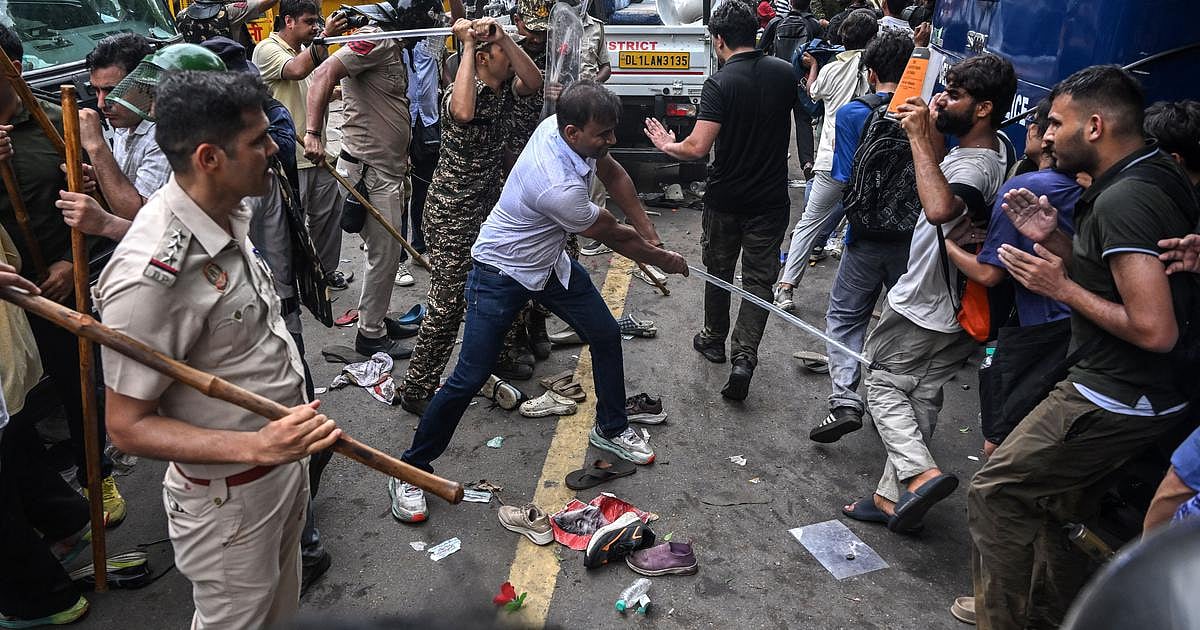
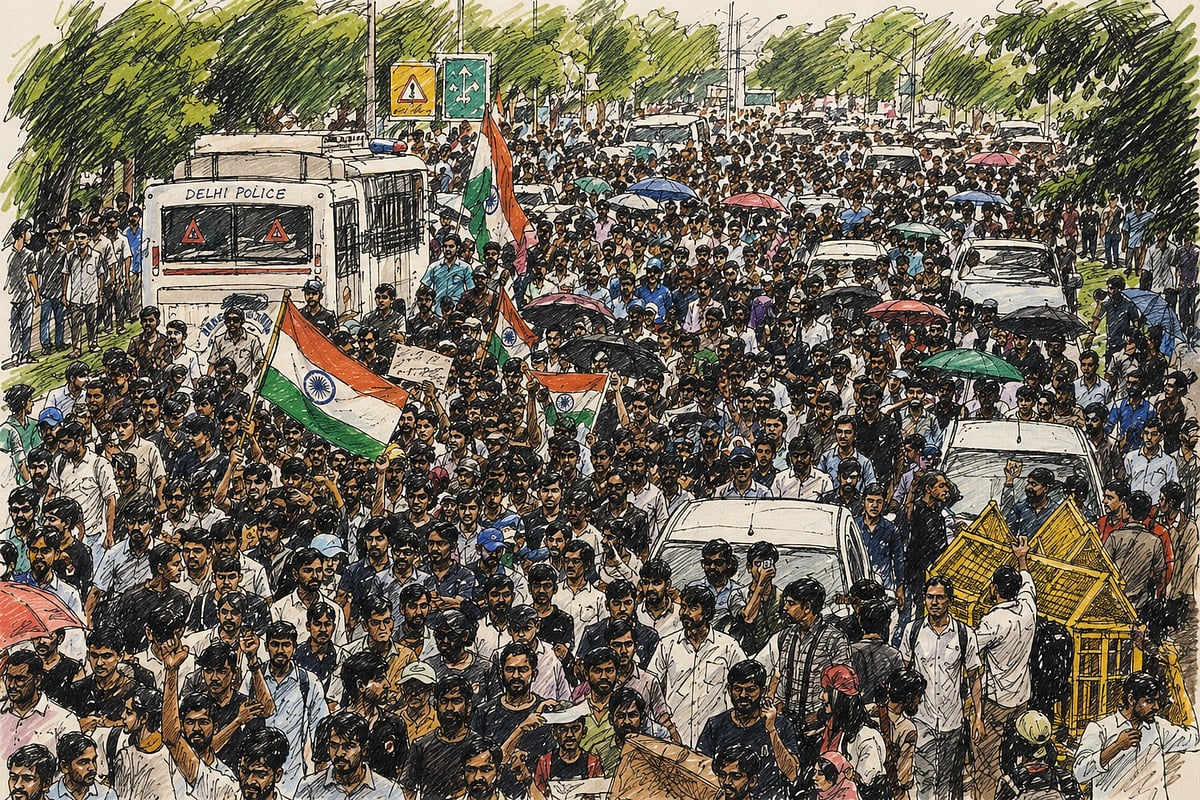
WHEN THE PEOPLE gathered at Jantar Mantar this Monday, fasting and chanting and holding copies of the Indian Constitution above their heads to demand that a Union minister answer for a leaked examination that had upended a generation, the Government of India had a tidy explanation for why they were blocked, detained and brutally beaten up: they had no ‘permission’, and that the gathering was unauthorized.
It is worth pausing on that word, ‘permission’. Permission is something superiors grant to subordinates, and to say that citizens may protest only with the government’s leave is to make the freedom to dissent, a favour the powerful lend to the powerless, revocable the moment it turns inconvenient. That is precisely what a fundamental right is not. The real question is this: is it right to protest without permission, and what does an unarmed protest carry that a free country must protect even when the paperwork is not in order?
To answer, it helps to begin far from Delhi. On October 21, 1967, outside the Pentagon, a girl of seventeen named Jan Rose Kasmir stood before a line of soldiers with fixed bayonets, holding a single chrysanthemum. Marc Riboud’s photograph of that moment has travelled further than most armies: on one side of the frame, helmets and uniforms and steel; on the other, a young woman with no hatred in her face, holding something that could be crushed between two fingers.
A flower cannot stop a bullet, but it can make the bullet explain itself. That is the power of peaceful protest, and why the quarrel over permission misses what matters most. The law asks whether the gathering was ‘authorized’, whether the road was blocked, whether order was disturbed. History, however, asks a harder question: what kind of order needs a bayonet to defend itself against a flower?
The real question is this: is it right to protest without permission, and what does an unarmed protest carry that a free country must protect even when the paperwork is not in order?
Peaceful does not mean polite
The Constitution guarantees every citizen the freedom of speech and the right to assemble peacefully and without arms, and those last words hold both the right and its only real limit. Peacefully does not mean silently, and without arms does not mean without anger. A protest that causes no discomfort to anyone in power is usually not a protest at all. It is a suggestion.
The Supreme Court has recognized peaceful protest as a fundamental right and a form of direct participation, the way citizens hold power to account between elections. The State may regulate the route, hour and manner in the interest of public order, but it may not regulate dissent quietly out of existence. Peaceful protest is not the absence of disturbance; it is the absence of violence. Nonviolent direct action, as Dr. King practiced it, was never the enemy of negotiation but the pressure without which the powerful had no reason to come to the table. It is not passivity but confrontation under a very hard discipline.
When breaking the law honours it
Here the language of permission finally fails, because lawful protest and rightful protest have never been the same thing, and the gap between them is the source of its moral power. In March 1930, before he walked to the sea, Gandhi wrote to the Viceroy an ultimatum that opened, all the same, with the words “Dear Friend”. He announced what he meant to do, called the salt law unjust, and walked from Sabarmati to Dandi to break it in broad daylight. This is the whole character of the satyagrahi: he does not slip past the law in the dark but breaks an unjust law in the open and accepts the prison that follows. He does not say the law has no authority; he says only that authority cannot make an injustice, just.
After Dandi, Gandhi was arrested, but the marchers did not stop, and at the Dharasana salt works unarmed volunteers walked in disciplined rows into the lathis of the waiting police. They were clubbed down, and others stepped calmly into their places, and the correspondent Webb Miller reported that the men did not even raise their arms against the blows. His dispatch went round the world: an empire beating unresisting men to guard its monopoly over a fistful of salt. The British still held the whole statute book; after Dharasana they held a little less of the thing that cannot be legislated back, which is legitimacy.
That is what satyagraha means when both halves are given their weight. Satya is truth; agraha is insistence, not a mild preference for the truth but a refusal to cooperate with its opposite, aimed always at the wrong and never at the worth of the one who does it. Peaceful protest carries two refusals at once: I will not obey injustice, and I will not become unjust in opposing it.