Hindutva, Dalits and Neoliberal Order
Published on: 16 April 2021, 08:14 am
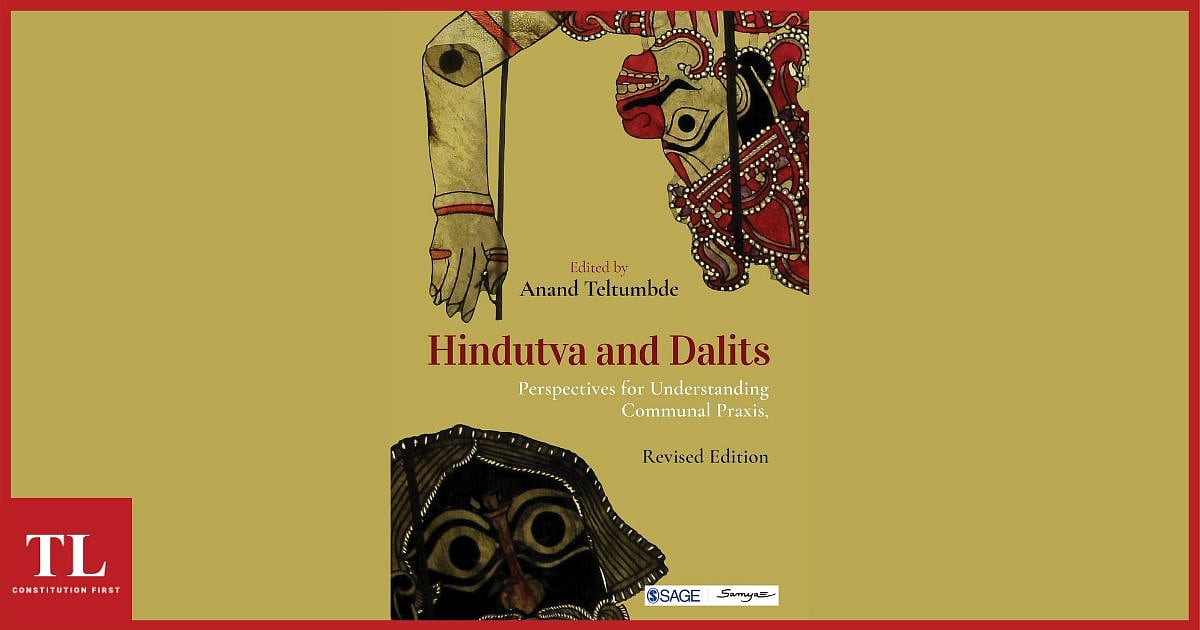
This is an extract from Hindutva and Dalits; Perspectives for Understanding Communal Praxis Edited by Anand Teltumbde and published by 'SAGE and Stree-Samya Books'. It contains essays by numerous writers like Shamsul Islam, Ram Puniyani, Meena Kandasamy, Suhas Palshikar and Martin Macwan.
—–
THERE can be a reasonable debate over whether the paradigm created by the political ascendance of the Hindutva could be called fascist. In absence of an established theory of Fascism, two approaches, Marxist and non-Marxist are generally considered to assess whether any movement or state is fascist.
The major difference between these approaches is in terms of their focus; while the Marxist approach has a focus on the characteristics of the fascist state, Fascism in its matured form, the non-Marxist approach has focused on movements; they are much more strongly pivoted on the elucidation of Fascism's distinctive ideological themes and organisational principles.
Apart from its insistence that Fascism can only arise in specific conditions (capitalism in crisis in the era of imperialism), Marxist approaches consider ascension of fascist forces to full state power represents the culmination of the logic of Fascism, not just an early transit point on a political dynamic. They may compromisingly call it as authoritarian, reactionary and anti-secular, and even as potentially fascist, but not fascist as yet.
A movement can be better assessed through its ideology and aspirations than its practice because the latter necessarily involves compromises. With such insights, we can use a framework that outlines certain 'fascist minimum' to assess the character of the Hindutva forces. Vanaik used the framework based on a three-part model by Stanley Payne, which comprises: (a) fascist negations (anti-liberalism, anti-democracy and anti-Communism); (b) generic ideological motifs and goals (state as an 'absolute'), expansionist foreign policy, subsuming individual autonomy, some collective 'Other' as the enemy, extreme authoritarian nationalism, an apocalyptic perception of deep 'civilisational crisis'; (c) special and common features of style and organisation (charismatic leadership, exaltation of youth and youthfulness of fascist leaders, violence is glorified, mass emotions through evocative symbols, and masculinity).
While on each of these criteria Hindutva scores quite highly; its fascist proclivities come out more clearly in its genesis and growth. Indeed, Hindutva's fascist character comes with its birthmark. After the fall of the Peshwas, the Brahmin rulers of Pune, the entire Brahmin establishment in Maharashtra was agitated to regain its lost rule. The spurt of rebellions by Pune Brahmins against the British can be easily traced to this motive.