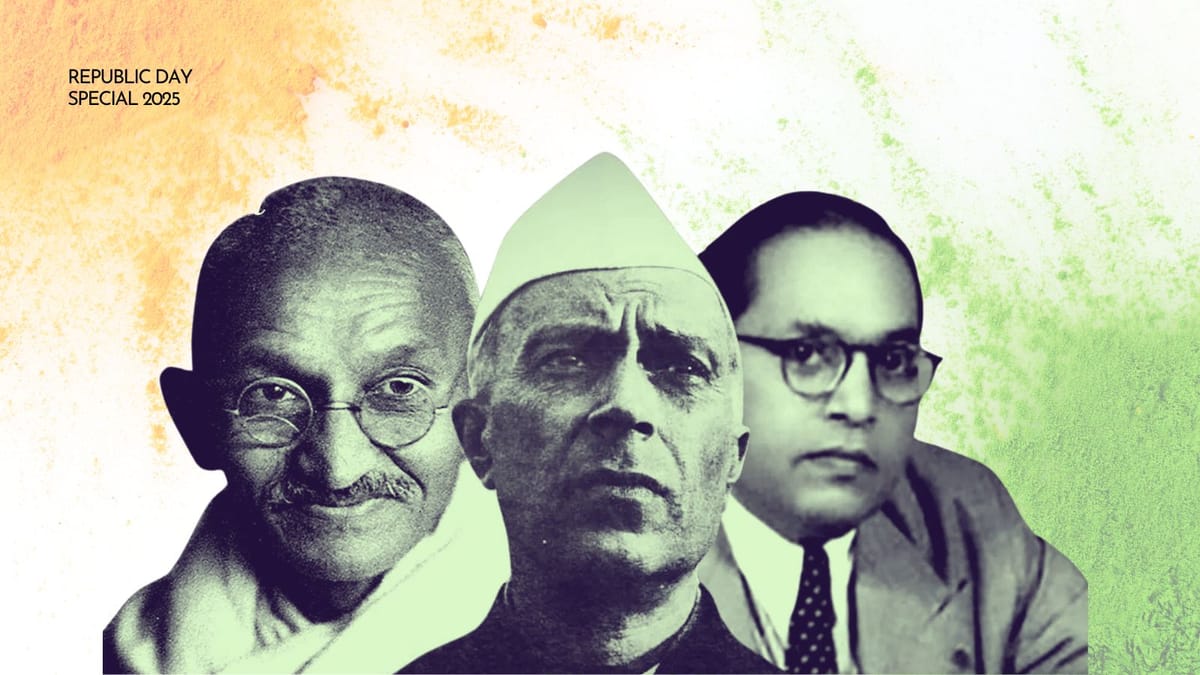
How Gandhi, Nehru and Ambedkar envisioned our republic, endangered by the current regime
We need to salvage this great republic. Only jana gana can do it, writes S.N. Sahu.
Published on: 26 January 2025, 08:46 am
WHILE Bal Gangadhar Tilak electrified the nation and accelerated the momentum of the freedom struggle with his historic slogan “Swaraj is my birthright and I shall have it”, it was M.K. Gandhi who, while speaking at Amravati on March 19, 1921, proclaimed that Indians had the birthright to establish a republic as there had been village republics in India from times immemorial.
That statement of Gandhi to fashion the destiny of India as a republic underlined the struggle of the freedom fighters to invest Indians with citizenship status which sharply negated their standing as subjects of the British monarch. It is instructive that Gandhi’s assertion to constitute India as a republic was a radical departure from its subservient role under the British monarch and so the British regime took harsh penal measures against those who persuasively mobilised people around the vision of converting India to a republic after achieving independence.
Eleven days after Gandhi’s articulation that Indians had a birthright to establish a republic, he explained in his notes, published in Young India on March 30, 1921 under the caption, “Repression and its Lesson” how one freedom fighter Cholkar was being persecuted for speaking in Nagpur for a republican form of government for India.
That statement of Gandhi to fashion the destiny of India as a republic underlined the struggle of the freedom fighters to invest Indians with citizenship status.
Gandhi stood in solidarity with Cholkar and forcefully remarked that if he faced the wrath of British rulers for the alleged offence of taking a stand in support of the Indian republic, then every Congressman would be held liable for committing the same offence.
He then affirmed, “For he will not hesitate to think of, and work for, a republic, if he could not gain his birthright without complete independence.”
B.R. Ambedkar, in his last speech in the Constituent Assembly on November 25, 1949, said that the Constitution would come into force on January 26, 1950 which would be the independence day for the country. This historical context is a categorical imperative to better appreciate the Objectives Resolution moved by Prime Minister Jawaharlal Nehru in the Constituent Assembly on December 13, 1946 and one of the key aspects of that resolution was to declare the firm and solemn resolve of the assembly “to proclaim India as an Independent Sovereign Republic and to draw up her future governance a Constitution”.
In fact, Nehru unequivocally stated, “India is bound to be sovereign, it is bound to be independent and it is bound to be a republic.” “I will not,” he remarked, “go into the arguments about monarchy and the rest, but obviously we cannot produce monarchy in India out of nothing.”
Nehru then asserted by saying, “It is not there. If it is to be an independent and sovereign State, we are not going to have an external monarchy and we cannot have research for some local monarchies. It must inevitably be a republic.”
Almost seven months after Nehru expressed the resolve to make India a republic, Gandhi, in a prayer meeting in Delhi on June 12, 1947, referred to the aforementioned initiative of Nehru and explained the meaning of the republic in four words, “...all will live together...”
That meaning of the republic that all will live together assumed enormous significance in the grim context of the dreadful carnage and displacement of people in the name of religion from India to Pakistan and vice versa. Delhi, where Gandhi was speaking in a prayer meeting, was witnessing massive communal violence and desecration of places of worship on an unprecedented scale. So Gandhi’s understanding of the republic was not by employing legal or constitutional terminologies but by proclaiming that “all will live together”.