On thinking and questioning
If a government’s decisions are informed by anything other than scientific thought and reason, it becomes a theocratic government
Published on: 27 April 2025, 05:18 pm
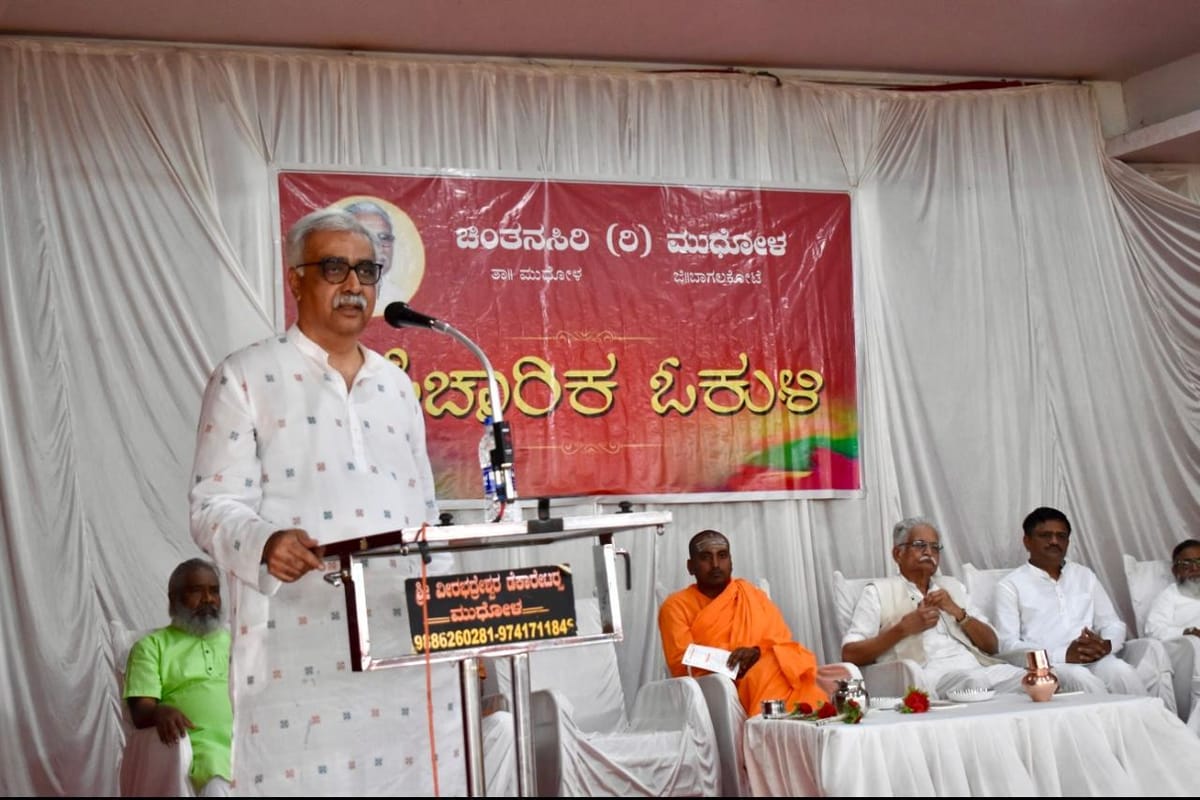
RECENTLY, I WENT TO MUDHOL in Karnataka to inaugurate the annual conference of Chintana Siri. When I was requested to inaugurate, I was surprised that Mudhol, the hub of enterprising sugarcane farmers, has chosen to start a platform on a subject with philosophical underpinnings. However, the reasons are not far to seek. It was the effort of Vasanna Desai, who contributed to the development in the area through his innovative approach of socio-political sensitisation of people. Unfortunately, he did not live long enough to reach the State legislature or Parliament to offer his ideas on a larger scale.
While thinking about what to speak, I wondered: if Chintan is what people in Mudhol want, why not have Chintan on Chintan? This provoked me to look to epistemological concepts of thinking, thoughts, and knowledge to promote inquisitiveness and Socratic questioning among people. The reason for provocation is that inquisitiveness and questioning have taken a back seat due to the simplistic and attractive nature of the information available on fingertips. Even though unverified, when the information is available on social media, it naturally attracts readers.
To my surprise, the large gathering of more than a thousand people, who were predominantly literate farmers, listened to my speech with rapt attention. Some of my friends who thought philosophical discourse might not help in holding the attention of people in rural areas were quite surprised.
Let me recapitulate (with some improvisation) in this piece what I spoke at Chintana Siri in Mudhol.
Even though unverified, when the information is available on social media, it naturally attracts readers.
Thinking, thoughts, and knowledge
At the outset, it is necessary to explain philosophical concepts before appealing to inquisitive thinking and Socratic questioning of who, where, how, and why. Firstly, thinking is a cognitive exercise involving decision-making. Secondly, thought is an idea, concept, or image generated by such thinking. However, knowledge goes beyond thinking and thoughts. Knowledge that is a true thought or belief is knowledge alone. Ideas generated in the mind have to be thoughtfully believed before concluded as true or false. If it is true, the idea will qualify as knowledge. However, the truth as absolute truth is not possible. It measures only as a degree of certainty.
The transition from idea or thought to knowledge should not be subjective decision-making of oneself, but it must be based on his or her objective test. What one thinks and believes cannot be a piece of knowledge. One’s belief ought to be reason-based, that is, supported by perception, testimony, and reasoning. A justified true belief is alone said to be true knowledge.
Of course, the truth is not absolute. The truth is a degree of certainty that varies depending on where we apply and for what purpose. The courts use three methods to test the truth of information: the prima facie test, which is applied while granting interim relief; the probable cause test, which is applied in civil cases; and the test of beyond a reasonable doubt, which is applied in criminal matters while judging the guilt of the accused.
Are thoughts real?
Are thoughts real? This has assumed importance in the age of Artificial Intelligence, even though it may sound metaphorical. However, when the subject is explored metaphysically and epistemically, there are opposite schools of thought on thoughts. Are thoughts real and part of larger material things, or are thoughts independent of the physical world as projections of the mind? This has been part of the metaphysical discourse for long, beginning from ancient Greek philosophy and Indic philosophy.