Contemporary Challenges before the Anti-Caste Movement
Published on: 23 April 2019, 11:34 am
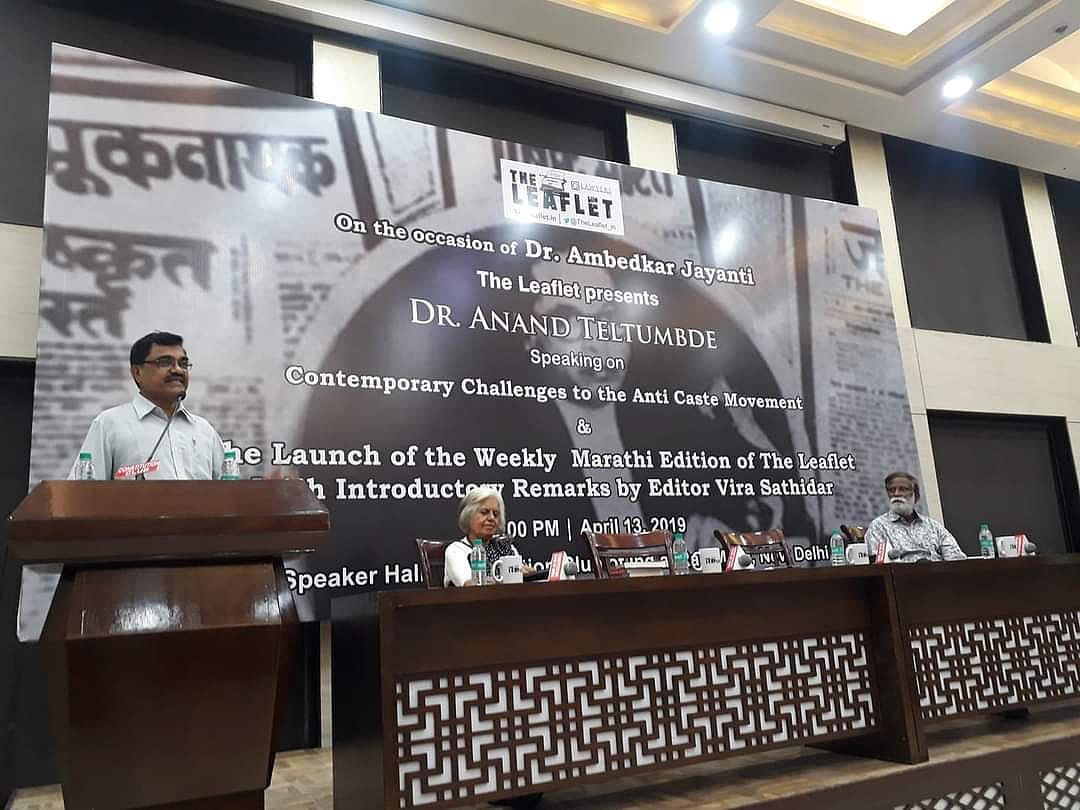
AT the outset, I would like to thank Indira Jaising and the entire team of the Lawyers Collective and The Leaflet for having me here to speak on the eve of the 128th birth anniversary of Babasaheb Ambedkar. I also congratulate The Leaflet team for its decision to launch a Marathi edition and wish it all the success under the stewardship of my friend Vira Sathidar. During the last five years, when we see the media, with an honourable exception of a few, completely capitulated to the ruling junta, the new genre of online media like The Leaflet have kept the fourth column of this limping democracy from crumbling. Most of them started in English by default but realised the need to go vernacular and I am happy that The Leaflet also decided to do so.
While many such remedial steps are going to help our democracy, I shudder to think whether they are not too late in the day. We are standing literally at a precipice where only a miracle could save us from an imminent fall into fascism of the worst kind. Yes, the Hindu Rashtra that India might become post-2019 election will be fascism of the worst kind, because none of its prototypes in Europe was endowed with the poisonous ideology called Brahminism that created the longest living man-made contrivance (system) in the world called caste.
As you see, the topic of my speech is "Contemporary Challenges before the Anti-Caste Movement". It may amuse you if I say, I do not see any anti-caste movement around. All the movements – and I use the plural here – that swear by Babasaheb Ambedkar and hence appear as anti-caste actually use castes as their staple to thrive as do the ruling class parties. Castes constitute their main plank on which their social and political existence depends. While all social and political movements are completely mired in caste, even the cultural and religious movements, such as those engaged with Buddhism are also not rid of the caste idiom. They function in the same ways as the pre-conversion caste organisation did. Even the Bahujan, Buddha's holy term, or worse, Dalit-Bahujan, are ridden with caste as they are primarily conceived on the basis of caste identity.
The anti-caste movement can only be spoken of in historical terms. It started with the advent of Brahminism, as the resistance from the Shramans, best represented by Buddhism and survived through the reforms of the previous century that ended with Babasaheb Ambedkar. The anti-caste movement necessarily faces the dialectics of assertion and negation of caste, which if not managed, may turn into its antithesis, the casteist movement. This is what has precisely happened to the Dalit movements. One thing which we forget to ask ourselves is whether the post-colonial state had anything to do with this as in appearance at least its beginning coincides with the end of the anti-caste movement.