Why did Gandhi say media monopoly leads to dictatorship?
On M.K. Gandhi’s Martyrdom Day, S.N. Sahu takes a look at his perspective linking dictatorship with control of media by the ruling party.
Published on: 30 January 2025, 06:58 am
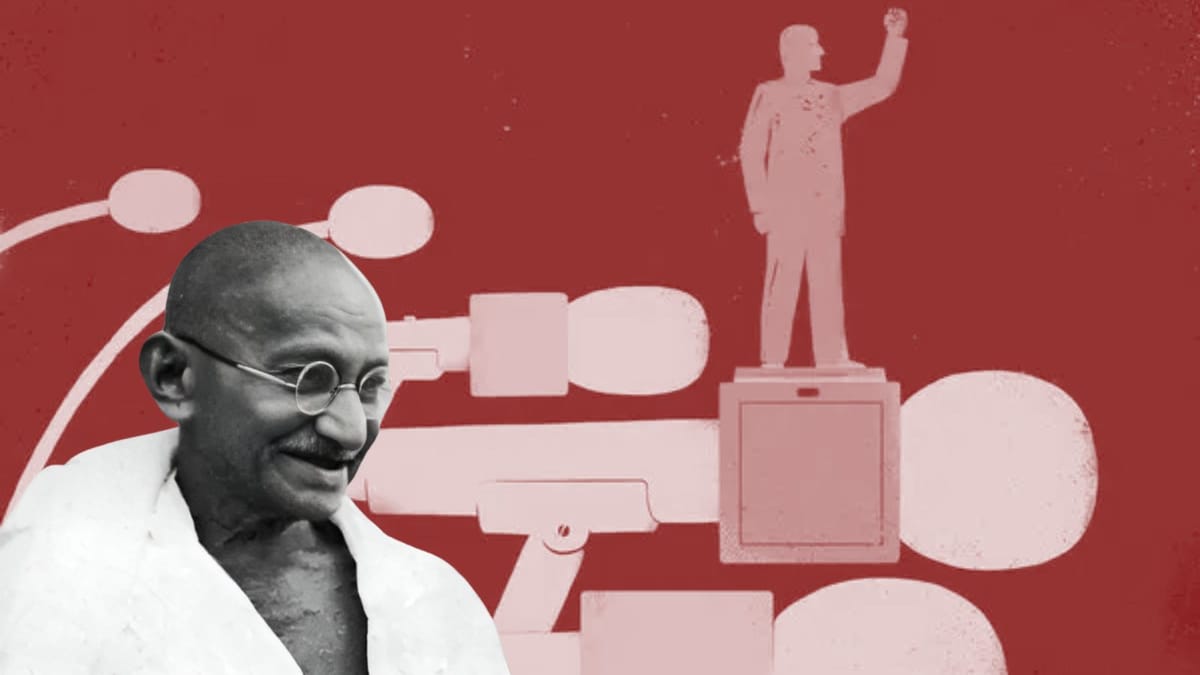
ON the solemn occasion of the 78th anniversary of the martyrdom of M.K. Gandhi, it is of seminal importance to recall his role as an outstanding communicator and his prescient and yet cautionary statement that if a political party with a mandate to rule exercises a monopoly over organs of information and communication, it would pave the way for dictatorship.
In fact, it is illuminating and instructive to note that he said so when the Constitution was being drafted by the Constituent Assembly and dire predictions were being made about the strong possibility of India failing to safeguard her newly acquired independence and bring to fruition its vision to set up a democratic form of government based on adult franchise.
It was during those trying times when Partition-related communal carnage was engulfing several parts of the country, many Hindus and Muslims were being killed and their places of worship desecrated due to the spread of hate on account of faith that Gandhi received a complaint that Indian National Congress was using radio for broadcasting information and news about itself and its activities.
Tragically, at the global level, India has been rated as an electoral autocracy and its rank among 180 countries in the Press Freedom Index has slipped to 159th position.
While addressing a prayer meeting on November 26, 1947, sixty-five days before his martyrdom on January 30, 1948, he referred to that complaint and prophetically said, “If the Congress uses the radio, etc., like this for its own propaganda, it is bound to bring about dictatorship in the end.”
Those apprehensions were uttered by Gandhi when there were only newspapers and radio as means of communication reaching out to a small segment of the population.
At that time, the Constitution was being framed with the Constituent Assembly pursuing through its activities to constitute India into a democratic republic anchored in the ideals of justice, liberty, equality and fraternity to create a new India celebrating the freedom of the people.
Those apprehensions of Gandhi have been materialised by the Narendra Modi regime in letter and spirit. It is amply evident by the manner in which it has captured media with a firm grip during the last eleven years for its own propaganda and image building of Prime Minister Modi.
What was done by Indira Gandhi's regime in censoring the media during the time of the Emergency spanning nineteen months from 1975 to 1977 could be understood because she was exercising powers mandated by the provisions of the Constitution dealing with emergency.
After she lifted the Emergency and schedules for conducting general elections were announced, the press was never subjected to the control of her government. In contrast, in today’s India, without a formal declaration of Emergency, a huge segment of media, be it TV channels, newspapers and even social media platforms such as Facebook and X, are relentlessly used for propaganda purposes by the Modi regime.
The term Godi media coined by Ravish Kumar refers to the realms of the press which act as the lap dog of the Bharatiya Janata Party (BJP) and Modi regime to transmit information and audio-visual content for serving the cause of the ruling party at the Union level.