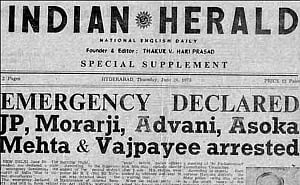
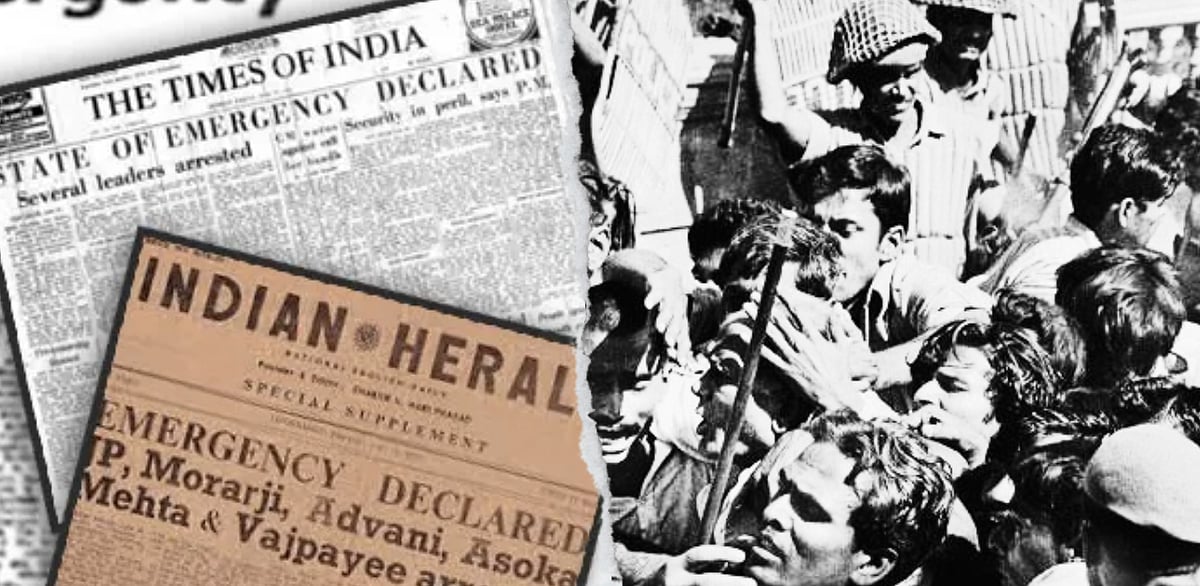
The Emergency, the first few days – A personal recollection
Published on: 25 June 2022, 09:35 am
That day we spent only finding out who all had been arrested and who had escaped the police dragnet. The next day, I had wanted to walk down to the Delhi State Socialist Party office and our trade union office. I was cautioned not to go anywhere near it. It was feared that Gobind, the office caretaker, was a police informer.
——
ON the morning of June 25, 1975, Than Singh Josh, the leader of the socialist trade unions in Delhi, and I had just reached Bangalore, as Bengaluru was then known. From the train station, we took an auto rickshaw to Subedar Chatram Road. We were going to the office of the Karnataka state Socialist Party. It was actually the office of K.G. Mahewarappa, a lawyer, who was a long time socialist. We were going to sleep there for the week.
The office consisted of two small rooms on the first floor over a row of nondescript shops on the ground floor. The road itself had not become such a busy area as it did in the late 1970s. The first room, with a table and a chair, and a few wooden benches, was the grand state office of the Socialist Party. The other room was the legal office of Mahewarappa. The room had the same kind of furniture that had served the test of time. A book shelf containing law books was the distinguishing difference between the two rooms.
Apart from a party worker who acted as caretaker, who let us in, no one was in the office. We had a wash, went downstairs, and had a dosa and some good coffee at a small eatery. Our instruction from Surendra Mohan, the then General Secretary of the All India Socialist Party, was to link up with Bapu Heddur Shetty, a Socialist student leader. We were to seek him out in the University Law College of Bangalore University. We took an auto rickshaw to the law college, and after some asking around and waiting, we were able to link up with him. He told us to come the next day, and he would get a group of students together for us to interact with. Our instructions were to get students on the streets in favour of the JP movement, as in other universities in central and northern India.