Un-Casted by Conversion?: Why Supreme Court’s Chinthada Anand Judgment Misses the Entire Point
By missing to apply a purposive and intersectional interpretation to the SC/ST Act’s application, the Supreme Court has robbed millions of Dalit Christians and Dalit Muslims of remedy against caste atrocities.
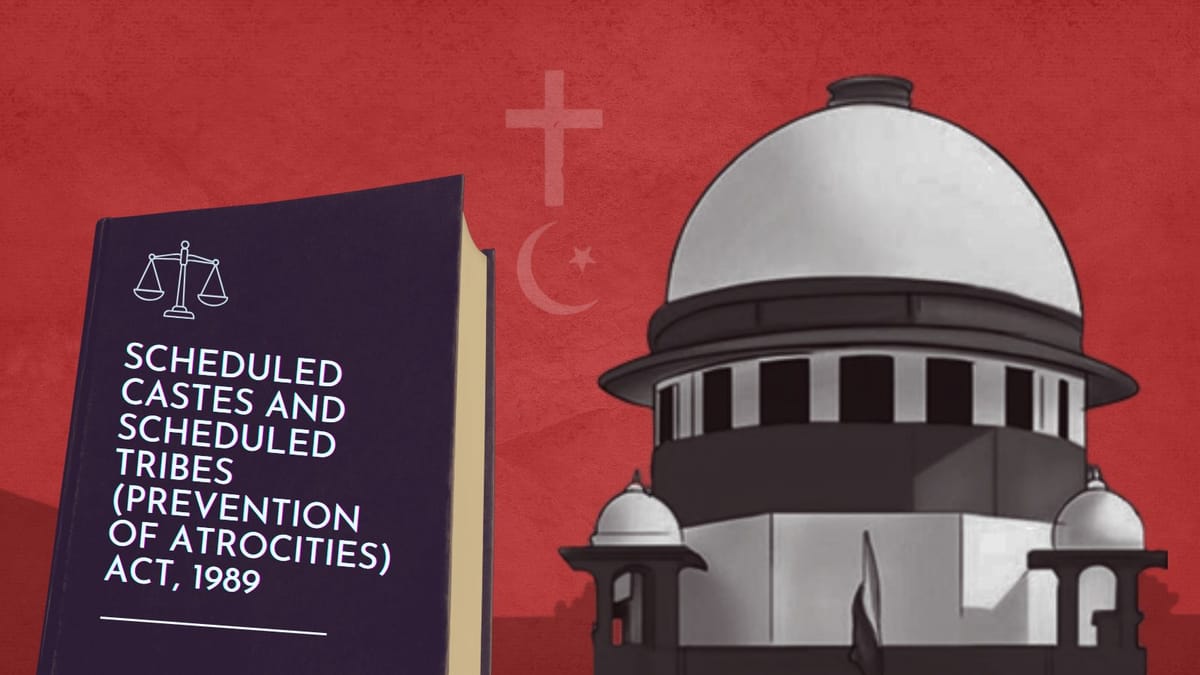
Published on: 1 April 2026, 09:58 am
THE RECOGNITION OF CASTE in the Constitution of India, 1950 was not an accident. It was a well-deliberated exercise of recognising what the Hindu, Brahminical order had cemented in Indian society through centuries of brokering power, status, and resources. While the institution of caste predates most faiths and belief systems that exist on the face of earth today, it is noteworthy that the institution itself is not a time-capsule, frozen in time. It keeps shaping and getting shaped by other belief systems that interact with caste— which can be seen in many interesting examples throughout the subcontinent. Be it the Roman Catholic Brahmins (the RCBs), or the Jatt Sikh and Mazhabi/Ravidassia Sikh binary— a faith unfamiliar with caste (Roman Catholicism) and a faith built upon the claim of egalitarianism (Sikhism) both show elements of caste when it comes to practice.
The Indian Constitution recognised the discrimination experienced by the Dalits, and classified the Dalit castes into a Schedule: thus the identity being called “Scheduled Castes (‘SC’)”. A similar exercise was done for the indigenous tribes in India, leading to their identification as “Scheduled Tribe (‘ST’)”. This was not merely an exercise in classification, but an exercise in recognition of a pattern which was common across the country, and hence required additional remedial measures. The measures began with the prohibition of untouchability, and further allowed the state to make laws for the benefit of, inter alia, these protected identities.
However, the Constitution (Scheduled Castes) Order, 1950, issued under Article 341, contains a categorical religious bar: it restricts SC status exclusively to Hindus, with subsequent amendments in 1956 and 1990 adding Sikhs and Buddhists respectively. The law presumes that only these “Hindu and Hindu-adjacent” faiths retain the stigma of untouchability.
The legal assumption that conversion provides an escape from caste is a fiction contradicted by centuries of Indian social history.
Does conversion legally extinguish caste status?
On March 24, in Chinthada Anand v. State of Andhra Pradesh(2026), the Supreme Court ruled that a person who has converted to Christianity cannot be recognised as a member of a Scheduled Caste. The appellant in the case was born into the Madiga community (categorised as SC) and later converted to Christianity and served as a pastor. He alleged that he was subjected to physical assault and caste-based slurs by members of the Reddy community in Guntur district, Andhra Pradesh. When he attempted to invoke the Scheduled Caste and Scheduled Tribes (Prevention of Atrocities Act), 1989 (‘SC/ST Act’), he was faced with a legal barrier— he was a Madiga in the eyes of the persons who invoked his caste in their caste-based slurs, but in the eyes of the law, he did not belong to a Scheduled Caste at all. The core issue framed by the Supreme Court in this appeal was – whether a person who professes a religion different from Hinduism, Sikhism, or Buddhism can remain a member of a Scheduled Caste to invoke the special protections of the special law, or does such conversion results in the legal extinction of their caste status?
The division bench of Justices Prashant Kumar Mishra and Manmohan held that the appellant’s decade-long service as a pastor constituted a public avowal of Christianity. Drawing on its previous decision in Punjab Rao v. D.P. Meshram (1965), the Court reasoned that once an individual adopts an egalitarian faith, their caste status is eclipsed. It is noteworthy that the “egalitarian faith” in question in Punjab Rao was Buddhism, which, back in 1964 when the case was heard, was yet to be included within SC status (as mentioned previously, it would only be included in 1990).Therefore, the Court in Chinthada Anand dismissed the reliance on state-level executive orders that offered benefits to converts, clarifying that such orders cannot override a Presidential Order. It consequently ruled that the SC/ST Act—a special legislation—could not be invoked by a Christian, regardless of the caste-based nature of the slur or the violence used against him.