Ambedkar, Vivekananda, Dyerism and the Sore of Caste Hierarchy
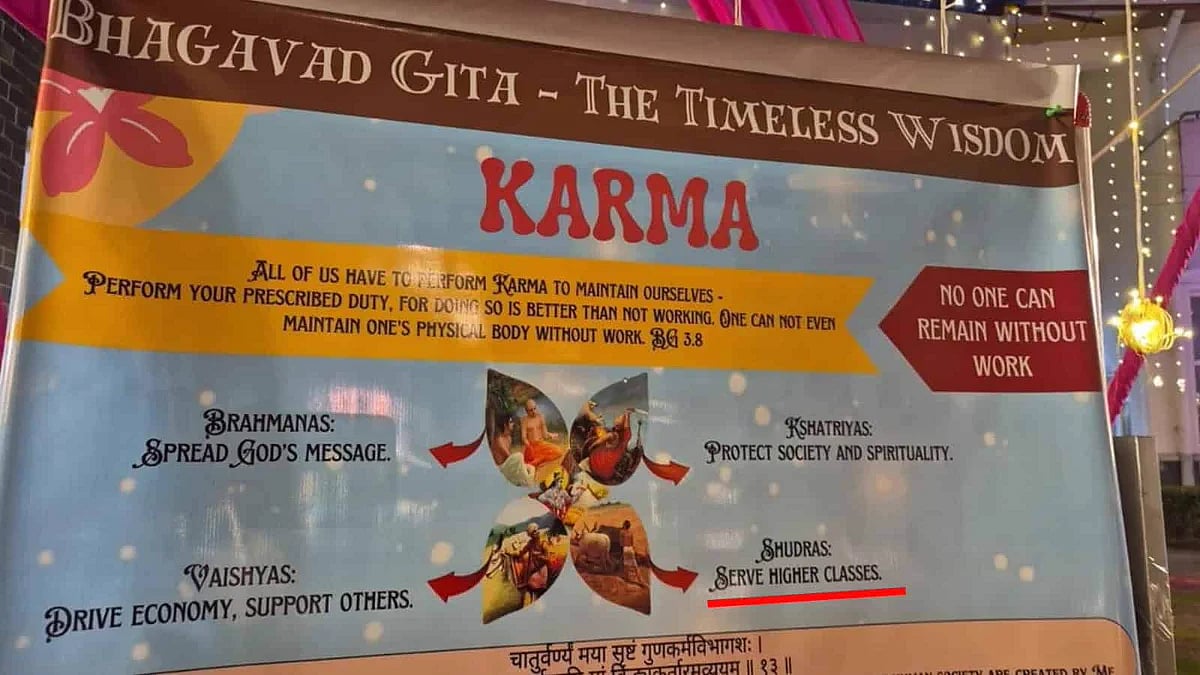
Dr. B.R. Ambedkar in ‘Annihilation of Caste’ wrote that “caste is a notion, it is a state of the mind.” Even earlier on November 20, 1930 while speaking at the fifth sitting of the plenary session of the Round Table Conferences held in London he brilliantly defined, in one single sentence, the caste system and the graded social inequality embedded in it. He said, “It must be recognised that Indian Society is a gradation of Castes forming an ascending scale of reverence and a descending scale of contempt—a system which gives no scope for the growth of that sentiment of equality and fraternity so essential for a democratic form of Government.” The IIT Mandi poster depicting Shudras in terms of their ascribed role for “serving higher classes” represents the stubborn persistence of the scourge of the caste system rooted in “…an ascending scale of reverence and a descending scale of contempt.” It is, therefore, violative of the Constitution and the constitutionally enshrined ideals of dignity and fraternity.
It is instructive to recall that Ambedkar in his last speech in the Constituent Assembly asserted that “The castes are anti-national.” Persuasively arguing that “they bring about separation in social life,” he forcefully remarked that, “They are antinational also because they generate jealousy and antipathy between caste and caste.” He then emphatically stated, “But we must overcome all these difficulties if we wish to become a nation in reality. For fraternity can be a fact only when there is a nation. Without fraternity equality and liberty will be no deeper than coats of paint.” Employing the logic of Dr. Ambedkar it could be said that the IIT Mandi poster condemning Shudras on account of their ascribed social attributes sadly points at an anti-national activity.
It is also painfully revealing that Swami Vivekananda, who emerged in the USA and many parts of the western world as a mesmerising Hindu monk in the late nineteenth century for his numerous illuminating lectures on Vedant and spirituality, was hurled abuses by some caste Hindus on the ground that he had no right to be Sanyasi because he was a shudra. He confronted those caste slurs after his triumphant return to India after he delivered several lectures including the famous Chicago address in the World Parliament of Religions in 1893. Vivekananda gave an account of that abuse in his book ‘Lectures From Colombo to Almora’ which contains the speeches he delivered in response to the rousing welcome accorded to him in Ceylon (now Sri Lanka), and different cities of India on his return from the US. In his address under the caption “My Campaign Plan” delivered in the erstwhile Madras, he said, “I read in the organ of the social reformers that I am called a Shudra and am challenged as to what right a Shudra has to become a Sannyasin”. Responding to such contemptuous casteist remarks he gave several explanations, one of which is worth quoting. He said, “….I am not at all hurt if they call me a Shudra” and then courageously confessed, “It will be a little reparation for the tyranny of my ancestors over the poor.” “If I am a Pariah,”(an outcaste), he proceeded to add, “I will be all the more glad, for I am the disciple of a man, who–the Brahmin of Brahmins–wanted to cleanse the house of a Pariah”.
It clearly shows that the festering sore of caste hierarchy rooted in inequality and contempt for those placed in the lower order of its scale has spared none including Swami Vivekananda. Its gory manifestation in the IIT Mandi poster underlines the arduous tasks ahead to ensure equality and equal opportunity to all regardless of identities defined, among others, by caste, faith, gender or ethnicity.
That was why Mahatma Gandhi drew a parallel between the heinous practice of untouchability and caste discrimination within Hindu fold with Dyerism attributed to the firing, ordered by Colonel Reginald Dyer, which massacred hundreds of unarmed people of diverse faiths at Jallianawala Bagh in 1917. He said that Dyerism caused frightfulness in the minds of its victims. In an article, “Untouchability and Nationalism,” published in the Navajivan on August 14, 1921, he wrote, “I have described untouchability as the greatest blot on Hindu society as the latter has been guilty of Dyerism in its treatment of the communities regarded as untouchable.”The IIT Mandi poster pouring scorn on Shudras tragically played out Dyerism a few weeks after India celebrated its 80th independence day.
Scholars have long argued that what sustains caste hierarchy is the belief in karmic principle, the idea that privilege in this life flows from conduct in a past one. Karma explains why a person is born into a particular caste; essentialism explains what caste inherently is. Together they render caste hierarchy not just persistent but, to those who hold the belief, justified and immutable. It is nothing but a continuation of social Dyerism rooted in the doctrine of frightfulness.
In 2023, the Times of India reported that the then Union Minister of State for Education, Subhas Sarkar, told the Lok Sabha that 13,600 students from reserved categories had dropped out of premier central universities, including IITs and IIMs, over the preceding five years. Rising dropout rates among marginalised students, set against rising suicide numbers, demand structural introspection into how these institutions actually function. Students from marginalised communities win the battle to enter premier institutions only to be defeated once inside by the caste discrimination embedded in them. The IIT Mandi poster is a glimpse of how deeply that hierarchical thinking persists, even among students at premier government institutions. It raises a direct question about whether the existing safeguards for marginalised students in these institutions work at all.